

Inigo Laguda, writer + musician
I think the political spectrum is born from a colonial perspective


Welcome to What’s Left! I’m Amy Hoggart, a writer/comedian with the ideals of a radical but the risk-aversion of a moderate. Each week, I interview someone interesting on the left about their personal politics and the state of the left today.
If you’re enjoying these conversations, please consider becoming a paid subscriber! This is a beautiful but also a time-intensive project, and I’ve kept the costs low to be accessible. Upgrading means you’ll get video and audio versions of the interviews every week, access to the whole archive of past interviews and the knowledge that you’re supporting my work 🧡.

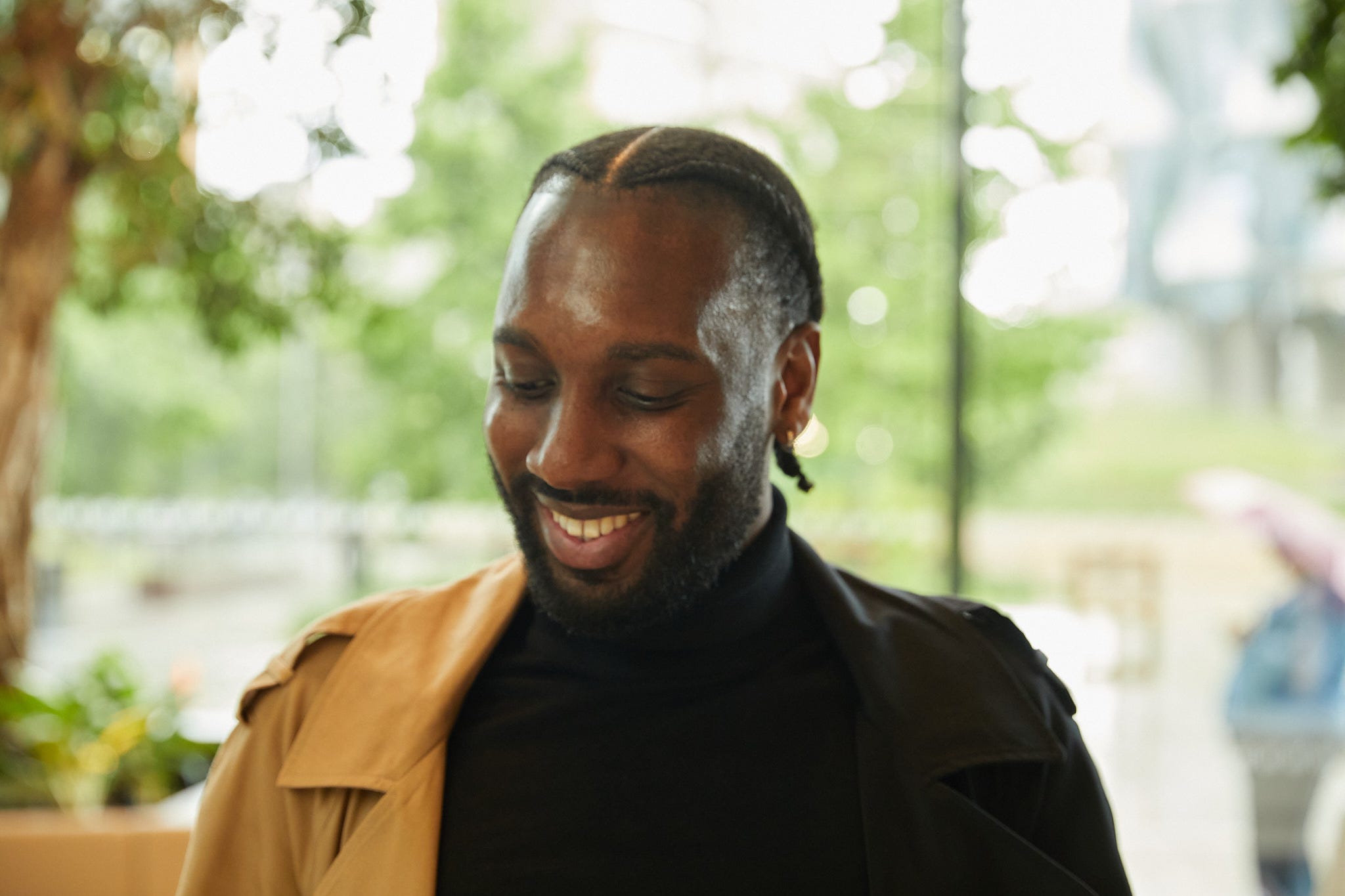
Inigo Laguda is a Yoruba-British author, essayist and musician from Hertfordshire, England. His essays have appeared on Netflix and The Metro. He received a special commendation for The Guardian & 4th Estate 2021 Prize, is an alumnus of the 2022/2023 London Library Emerging Writers Programme and was shortlisted for the 2024 Future World’s Prize. He writes regularly on Yours Inigo.
Watch or listen to our whole conversation here!
Welcome Inigo, thanks so much for joining me. The first question I always ask is this: if there was a version of the political spectrum where zero means you’re a total centrist, -100 a full fascist and +100 a radical leftist, where would you put yourself?
That’s a good question, but I don’t know if I would live in that spectrum. Many of my ideas align with leftism, maybe specifically anarchism, but so much of what I write about is wanting to abscond or live outside the political spectrum of left and right.
I think the spectrum itself is born from a colonial perspective. It’s always going to be steeped in that logic. By identifying with leftism, you become beholden to its tenets. Order and organization are important, but I feel like a free agent.
I’m an artist and musician, so the need to identify with those categories isn’t super necessary for me. I don’t claim to have answers, I’m examining the world in service of art.
I’ve heard so many criticisms of the left-right spectrum, but this is a new one. How is it colonial?
I was reading something by Marx recently about Britain’s colonial past in India. From what I understood, much of Marx’s thought outlines how societies move toward socialism and eventually communism: a progression from feudalism to capitalism and onward. When discussing India, there’s this idea that colonialism, while not good, was almost necessary as a gateway between feudalism and capitalism. I may be butchering that, but that was my reading.
In conversations with leftists, I often encounter the idea that colonialism was inevitable. I push back on that. I don’t think it was necessary. It happened, and because it happened, it becomes prescriptive, as if there were no other possible paths. But there were other ways societies could have developed. Cultures outside Western frameworks have existed without that level or type of colonialism.
It reminds me of something else. I recently watched a video about the Fermi Paradox and Great Filter Theory. The paradox asks: if the universe is so vast and old, why has no other intelligent civilization has contacted us? And The Great Filter theory suggests that civilizations destroy themselves before they reach the point of interstellar travel. There’s often a list of developmental steps a civilization must pass through and the final step is sometimes described as a ‘colonization explosion.’
What interests me is how rooted in colonial thought that framework is. Maybe there are advanced civilizations that see what we’re doing and want no part of it.
Ha ha.
There are many possible explanations for the silence. The assumption that expansion and colonization are natural endpoints reflects Western colonial logic. That logic seeps into politics, science, health and even leftist thought.
The colonial idea of constant expansion and accumulation feels so unnecessarily excessive to me. Why is ‘enough’ never enough?
I think about that a lot.
If I had to name a framework that resonates with me, it would be ‘Afropessimism’: a school of thought developed by Frank Wilderson and informed by thinkers like Saidiya Hartman. It repositions Marx’s idea of the proletariat by arguing that the worker is still considered human, whereas Blackness, as constructed through colonial and imperial thought, is positioned as non-human.
The idea of Blackness is structured through a slave/master dynamic that produces gratuitous violence beyond exploitation. Exploitation explains many things. But there are forms of violence against Black people that exploitation alone doesn’t account for. Afro-pessimism helped me make sense of that, especially after reading Marx and other leftist theory.
When you say violence against Black people can’t always be explained by exploitation, what do you mean?
What led me to Afropessimism was seeing repeated instances of police brutality. These deaths cost the state money; they’re expensive. So what’s the gain?
Oh wow.
You could argue there’s a roundabout way to link it back to exploitation, since exploitation is so embedded in the world we live in. But there’s also a pattern of gratuitous violence against Black people throughout history and across the globe; violence that doesn’t always make economic sense.
Afropessimist thought talks about the libidinal economy’: how beneath the economy of labor and exploitation is an economy of desire. There was, and is, a desire for Black subjugation that supersedes profit.
Slavery eventually stopped being profitable in many contexts. Revolts were frequent and yet the structure and the violence persisted. That’s what exploitation alone can’t explain.
I also felt a kind of frustration with how many leftists focus so centrally on labour. By focusing on labour, we risk missing the heart of what is human. Labour has been made integral to colonial and Western thought. But there may be something more spiritual or ancestral about human existence that isn’t reducible to work.
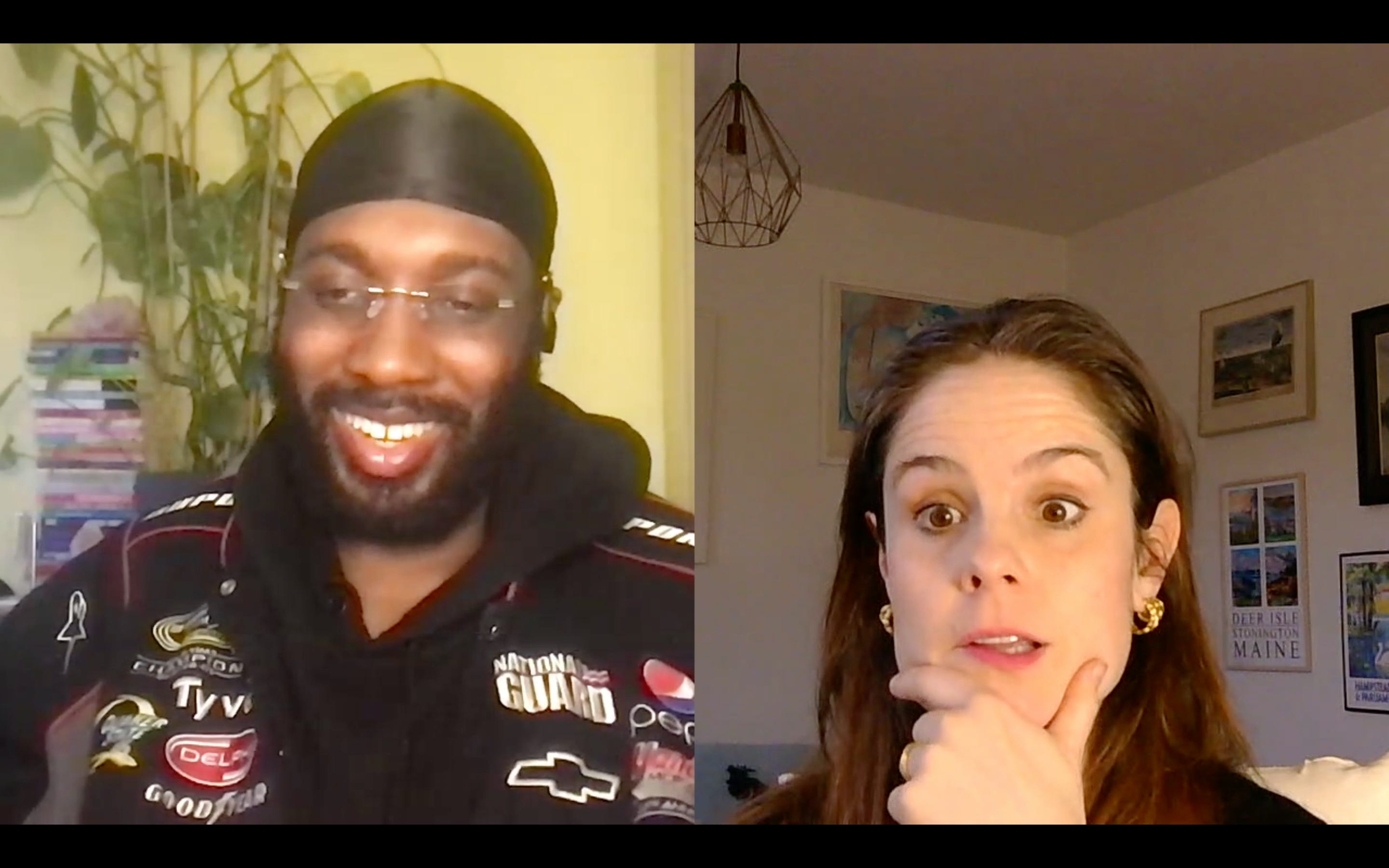
This is so fascinating. Marx was writing during a specific historical context, really at the height of the British Empire. We’re still talking about him today, but surely the thinking needs updating? I wonder whether a lot of these grand theories come from very educated white men who assume their perspective is universal.
It’s what you said: there’s a logic treated as universal when it’s actually very specific. Another example is this new TV series of ‘Lord of the Flies’. I remember reading it in secondary school and being told it was an examination of the human psyche. But I remember thinking, even without the language for it then: these are white boys.
It’s the psychology of a very specific type of boy: not even just white boys, but upper-class boys, boarding school boys. Their brutality can’t be extrapolated as human nature in general. But that move happens constantly in philosophy and in art.
When a film by a white director is considered transcendent, the implication is that they’ve tapped into something universally human that transcends race, culture, ideology. The same is said about William Shakespeare. If a Chinese author from the same era had global dominance behind them, that would be considered the universal experience.
I don’t say this dismissively. Supremacy often turns inward and harms the people it’s meant to protect. Now that patriarchy is being questioned, white men struggle, because they never developed a specific sense of self, only a presumed universality.
When I look at the state of the world, I often see the fantasy of a white man presented as universal reality. Of course, there are shared elements of human emotion across groups. But there is no universal experience, everyone has a specific one.
‘Lord of the Flies’ has always driven me mad. I recently read that Rutger Bregman looked into real-life cases of kids marooned on islands, and they cooperated and cared for each other. Yet Golding’s dark vision still dominates the school syllabus. Whereas when non-white authors or women write books, it’s framed as a specific experience, never universal.
Exactly. That framing shapes us deeply.
We have to unlearn so much of it.
Ok, I have a knee-jerk reaction to the word ‘unlearn.’ I don’t think unlearning is possible.
Oh interesting. Can you tell me about that?
Learning is like biking through snow: you leave a trail. Once it’s there, you can’t erase it unless new snow falls. You can only create new paths.
I can’t unlearn misogyny. What I absorbed growing up was everywhere and it will surface sometimes. But I can learn better ways of being. The same applies culturally: we can’t ‘uncolonize’ in the sense of erasing history. It stays with us.
If we accept that, maybe we can approach each other with more compassion. ‘Unlearning’ implies completion: you once believed something and now you’re cured of it. That’s not realistic. Much of what we’ve absorbed isn’t our fault. What matters is choosing to do better.
I wrote a piece called ‘Men Who Can’t Say Sorry’, and I’ve been thinking about how punitive our culture is.
I loved that piece.
Punitivity is everywhere. It seeps into our language. There must be accountability and consequences for harm, but where’s the balance? How do we distinguish ignorance from malice when you can’t see someone’s heart?
We’re taught not only to avoid being wrong, but if we are wrong, to not admit it. There’s also the instinct to lie to avoid consequences. If consequences are punitive, people will avoid punishment. And punishment drives behavior underground. Lying becomes a survival strategy.
That breeds a society where people will even try to change reality rather than appear wrong. You see it in certain debate cultures: people twisting facts in real time rather than conceding. In a punitive society, accountability is avoided. That avoidance stacks up untruths and makes progress difficult.
I watched an interview recently between Mehdi Hasan and an Oxford professor who had written a book about colonialism that leaned toward apologism. He’s an ethics professor. When ethical arguments became too difficult, he retreated into relativism: saying morals were different at the time.
So a kind of historical relativism?
Exactly. And I think there was a specific moment in that discussion where another panel was asking the professor questions. The topic shifted to apologies, and the professor said, ‘What’s the use of an apology?’
I always find that interesting. If that’s how you feel, then apologise. If it won’t matter, then just do it.
Ha ha.
But then the issue is that it wouldn’t be sincere. And the cost of that insincerity is where we are today. There’s a direct correlation between institutions crumbling in America and Britain and the refusal to say sorry for what’s been done.
So how much does action matter? Because whenever the royal family occasionally vaguely apologises, I always think: you’re billionaires. Don’t just say sorry, actually do something, pay reparations. Without action, what does even a sincere apology actually mean?
If Britain or America actually paid reparations to Black people, their economies would collapse. The Western world is sustained by the blood of Black people. If you said sorry and meant it, you’d have to transfer enormous wealth to Africa and beyond.
That’s why the apologies won’t come: there isn’t enough remorse, and there’s too much at stake.
Reparations were paid to Jewish people and to Japanese Americans for internment. But when Black scholars call for reparations, Western scholars say no. Suddenly it’s ‘too long ago.’ That’s Afropessimism in action: the idea that you ontologically don’t deserve reparations.
If you had a soapbox at Hyde Park Corner this weekend and one topic to shout about, what yours be?
We should make it law that every MP is paid minimum wage, or London living wage at most. If they don’t like it, they can raise the minimum wage.
That’s so good! I recently heard Rory Stewart argue that MPs need higher wages so they’re not tempted by bribes. But surely they could also just not take bribes?! You can’t simply pay people more to stop them being corrupt.
Exactly. They’re on around £93,000.
That’s so much! I hadn’t realised.
Yeah, £93,000 and bear in mind they have a schedule like schoolchildren. They get six weeks in summer, several weeks at Christmas. The recesses are long.
I’ve held this view for a long time, so when I heard that clip from Rory Stewart, I thought it was ridiculous. If he’s saying people already earning a lot are inclined toward corruption because it’s ‘not enough,’ what does that imply about people living below the breadline? What does that say about people with no money who steal to survive?
Right, and what’s the exact number where an MP suddenly isn’t tempted by corruption? £105,000? £110,030.72?
It shows the mental gymnastics. Why isn’t the first move stricter anti-corruption laws?
Exactly. I’m glad you jumped in with a nice, neat solution. Here’s a cheeky question: have you ever knowingly dated or slept with a conservative?
No.
Confident!
It doesn’t appeal to me. I’m also an artist, so my proximity to conservatives is low.
A lovely life. Do you have political reading recommendations?
‘AfroPessimism’ by Frank Wilderson. It’s part memoir, part theory. He lived through ‘60s and ‘70s America and moved to South Africa during apartheid. It frames anti-Blackness as a global condition. I think anyone on the left should read it either to challenge or supplement their thinking.
That’s great, I definitely will be. And so, as an Afropessimist yourself, are you optimistic about the future?
I don’t think in terms of optimism or pessimism. I think in terms of action and inaction. Even in the worst-case scenario—nuclear war—the earth survives. Life resets. My attachment is as much to the planet and ecosystems as to humanity. From that perspective, there’s still optimism.
Bringing it back to humans: change depends on action. The left talks a lot about organizing, but I’m pessimistic about whether organization can happen in our current mode of relating. We need to change how we speak to each other and how we enact theory.
The right has modernized. They don’t root themselves in 19th-century thinkers. They strategize. I’d say one early chess move was Fox News in the ‘90s.
They’ve had a long-term plan for a long time, I totally. Is there anything you’d add about your own politics or the state of the left?
Nothing I’ve said feels like gospel. I’m trying to figure out how to affect change without getting stuck trying to convert everyone.
We need to understand our roles. Are we educators? Organizers? Protectors? Not everyone plays the same part. The infighting comes from not understanding the ecosystem because it doesn’t feel coherent.
We also need less punitive reflexes. If someone expresses one controversial view, and we ostracize them, that can push them across the aisle. Before, I might’ve called them fake leftists. Now I think more strategically: who’s useful where?
There needs to be more focus on bringing things into fruition, less obsession with purity. However that has to happen, it needs to happen.
That’s really beautiful. Thank you so much.
Thank you.
Watch or listen to our whole conversation here!
If you’re like me, Inigo will just have given you a lot to think about! He writes really thoughtfully and beautifully on his own newsletter which I’d highly, highly recommend subscribing to now!

Previously on What’s Left?


 | A guest post by
|